
What's the difference between kJ and kcal?
You've seen both numbers. But what do they actually mean?
You're trying to track your food. Your app asks you to log calories. But the packet in your hand shows kilojoules. So you either guess, skip it, or open three different tabs trying to figure out the conversion. Sound familiar?
This is one of the most common points of confusion for anyone starting out with food tracking in Australia, and it's completely unnecessary, because the answer is actually very simple. Let's fix it.
The simple answer
Kilojoules and kilocalories are both just units of energy. Like kilometres and miles, they measure the same thing, just on a different scale. Neither one is more accurate or more "correct" than the other. They're just two different ways of expressing the same number.
So what exactly is a kilocalorie?
A kilocalorie (kcal) is the amount of energy needed to raise the temperature of one kilogram of water by one degree Celsius.
Yes, that sounds very science-y. In practice, all you need to know is that when someone says "calories" in the context of food and nutrition, they almost always mean kilocalories. The two words are used interchangeably, even though technically a "calorie" (lowercase) is actually 1/1000th of a kilocalorie. Don't worry about that distinction, nobody in nutrition means the small calorie when they say calorie.
kcal = what most apps, trackers, and nutrition guides use
And what is a kilojoule?
A kilojoule (kJ) is simply a metric unit of energy, part of the International System of Units (SI), which is the modern metric system used globally for scientific measurement.
One kilocalorie equals approximately 4.184 kilojoules. That's the only maths you really need to know.
kJ = what Australian food labels use
Why does Australia use kJ instead of kcal?
Great question, and the answer is straightforward: Australia adopted the metric system in the 1970s, and kilojoules are the metric unit for energy. Food Standards Australia New Zealand (FSANZ), the official body that governs what goes on Australian food labels, requires energy to be displayed in kilojoules.
This is why every packet, tin, and tub you pick up in an Australian supermarket shows kJ. It's not arbitrary, it's standardised.
The confusion arises because most of the nutrition content we consume online, apps, YouTube, podcasts, influencers, comes from the United States, where calories (kcal) are the norm. So Australians end up living in two systems at once, which is genuinely annoying and nobody warned us about it.
So why do most apps use kcal?
Because most apps are built in the US or for a global audience that defaults to calories. MyFitnessPal, Cronometer, Lose It, all kcal by default, though many allow you to switch to kJ in settings if you prefer.
This is also why food entries in these apps can be inconsistent or just plain wrong for Australian products, the data is often sourced from American databases, entered by users, or converted imprecisely. But that's a whole other post.
How do you convert between kJ and kcal?
Here's the only formula you need:
Divide kJ by 4.2 to get kcal
Multiply kcal by 4.2 to get kJ
The precise multiplier is 4.184, but 4.2 is close enough for everyday use and much easier to remember.
A quick example: A tub of yoghurt shows 650 kJ per serve. 650 ÷ 4.2 = approximately 155 kcal
That's it. No apps required.
Which one should you use?
Whichever one you'll actually stick with consistently, that's the honest answer.
If you're tracking in an app that uses kcal, use kcal. If you prefer to work in kJ because that's what's on your food labels, use kJ. The most important thing is that you're consistent, because mixing the two without converting is where people get into trouble.
Most people find it easiest to track in kcal since that's what the majority of nutrition content, guides, and references use. In the Australian Calorie & Nutrition Guide, I’ve done the conversion for you, so whether you prefer to track in kJ or cal, you’re covered:
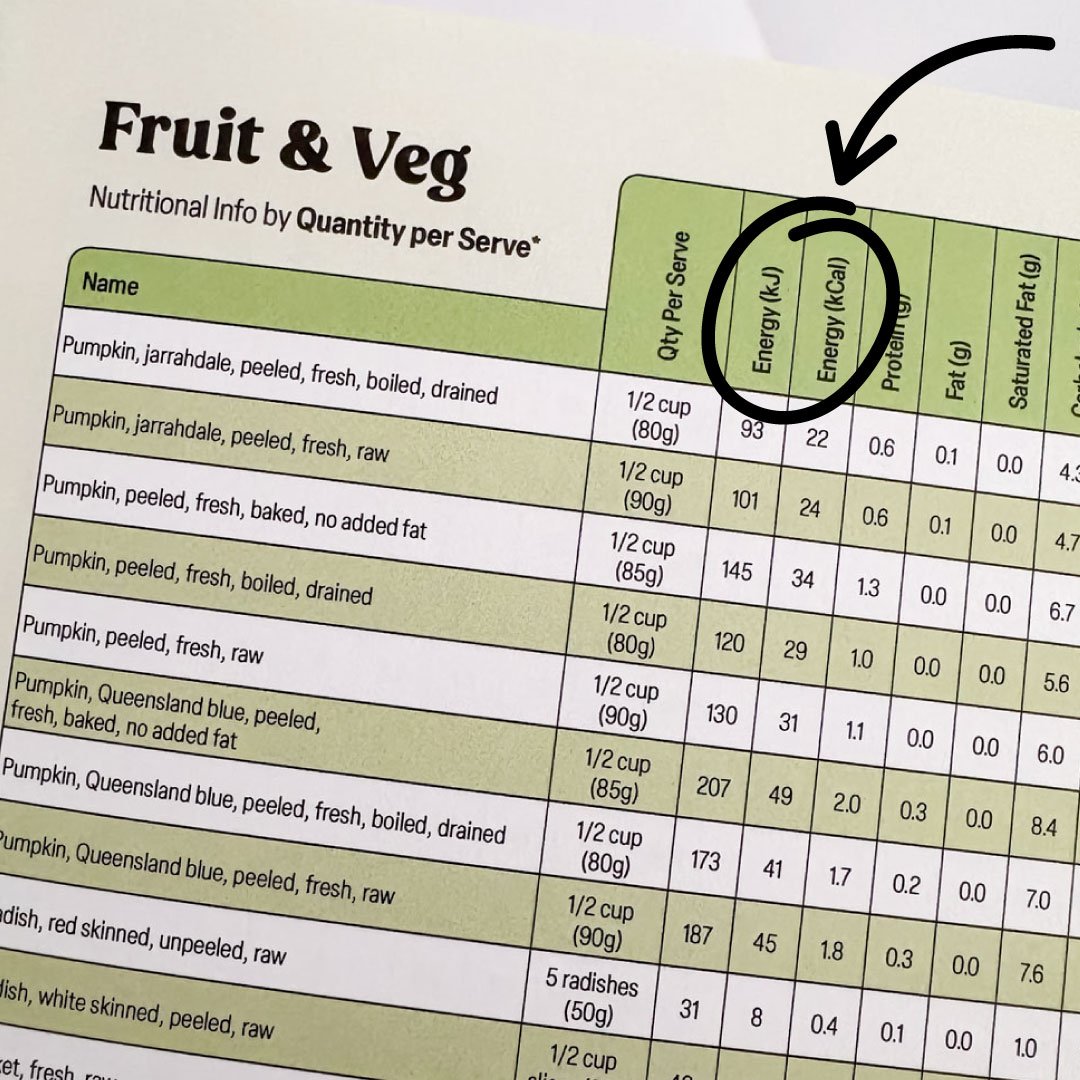
Australian Calorie & Nutrition Guide
The practical takeaway
Next time you're checking a food label and need the calorie count, just divide the kJ number by 4.2. That's your answer. You can do it in your head, on your phone calculator, or just bookmark this page for reference.
And if you want all of this in one handy reference, including how many calories are in each gram of carbs, protein, fat and alcohol, grab the free Nutrition Cheat Sheet here. It's the one page I wish I'd had when I started.
The bottom line
kJ and kcal are both just units of energy measuring the same thing. Australia uses kJ on food labels because of the metric system. Most apps use kcal because most apps are American. Divide by 4.2 to convert. That's genuinely all there is to it.
Want to track your food the simple way? The Australian Calorie Counter & Nutrition Guide has accurate, FSANZ-sourced data for thousands of Australian foods, organised the way you actually shop.
