
How to actually read an Australian nutrition label
You pick up a packet, flip it over, and immediately feel overwhelmed. Here's how to make sense of every single part of it - using a box of Weet-Bix as our guide.
Why the label exists
Every packaged food sold in Australia is required by Food Standards Australia New Zealand (FSANZ) to display a nutrition information panel. The goal is simple: to give you accurate, standardised information about what's in your food so you can make informed choices.
The problem is that most of us were never actually taught how to read one. So we either ignore it entirely or fixate on one number (usually calories) without understanding the full picture.
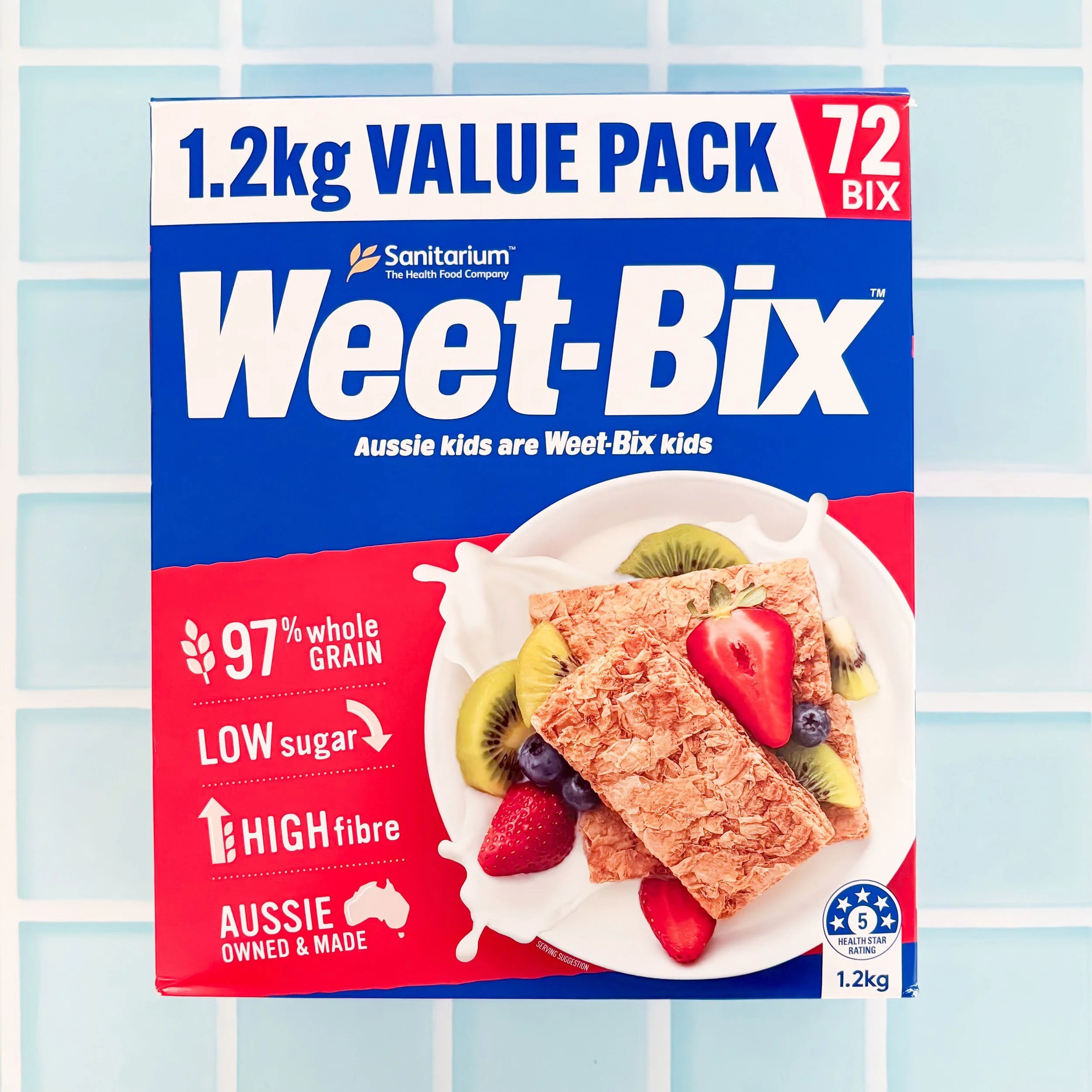
Let's change that. We're going to walk through a real Australian label - the Weet-Bix box - and break down every single part of it.
Part 1: The Nutrition Information Panel
This is the table on the back or side of the pack. In Australia it's always called "Nutrition Information" and it always follows the same standardised format, which makes it easy to compare products once you know what you're looking at.
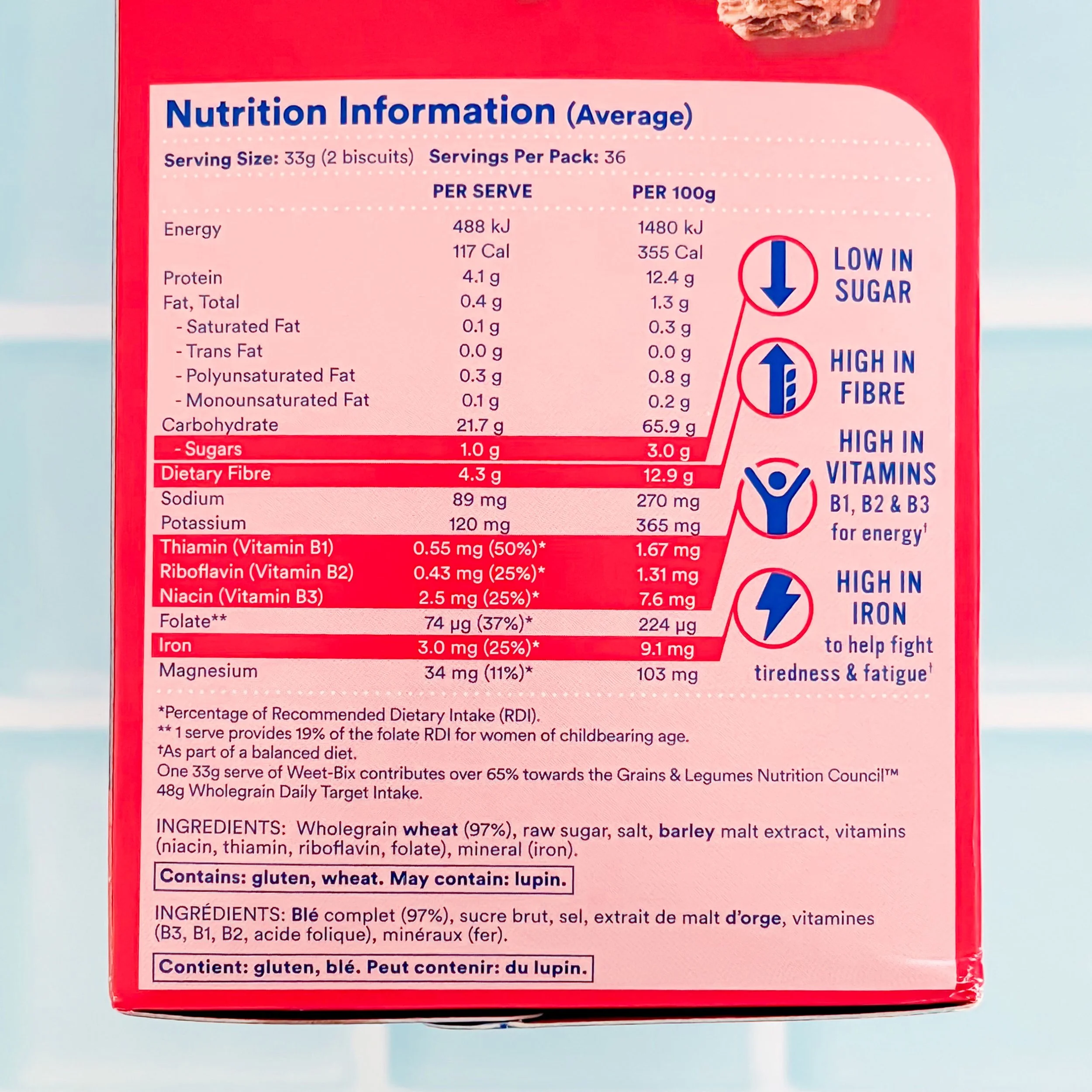
The heading: "Nutrition Information (Average)"
That word "Average" is important and easy to miss. The numbers on the label are averages - they represent the typical nutritional content of that product but can vary slightly batch to batch. It's accurate enough to be useful, just not to the single gram or kilojoule.
Serving size and servings per pack
The first line tells you: Serving Size 33g (2 biscuits), Servings Per Pack 36.
This is one of the most important things on the label and one of the most commonly misunderstood. Everything in the "Per Serve" column is based on this 33g serving - 2 biscuits. If you have 4 biscuits, you need to double every number in that column.
The servings per pack number (36) is useful for understanding how long a product lasts and calculating total cost per serve, but it doesn't affect the nutrition numbers directly.
Per Serve vs Per 100g - which column do you use?
This is the question that trips most people up, and the answer depends on what you're trying to do.
Use Per Serve when you want to know what you're actually eating. If you have 2 Weet-Bix for breakfast, the Per Serve column tells you exactly what went into your body: 488 kJ (117 Cal), 4.1g protein, 21.7g carbs, 0.4g fat, 4.3g fibre.
Use Per 100g when you want to compare two products. Because serving sizes are set by the manufacturer and vary wildly between products, the Per Serve column can be misleading for comparisons. Per 100g is a standardised measure that puts everything on an equal footing. Want to compare two cereals? Use the Per 100g column.
Energy
Weet-Bix shows: 488 kJ / 117 Cal per serve.
Australian labels are required to show energy in kilojoules. Many also show kilocalories (Cal or kcal) as well, which Weet-Bix does here. If you're tracking in an app that uses calories, 117 Cal is your number. If you need to convert a label that only shows kJ, just divide by 4.2. So 488 ÷ 4.2 = approximately 116 calories. Close enough.
Protein
4.1g per serve for Weet-Bix. For a cereal that's actually a reasonable amount - not high protein by any means, but a solid contribution to your daily total, especially if you're having it with milk which adds more.
Protein is listed in grams and is one of the most useful numbers on the label if you're paying attention to your intake.
Fat, Total - and the breakdown underneath
Total fat for Weet-Bix is 0.4g per serve - very low. Underneath the total you'll see a breakdown:
Saturated Fat: 0.1g
Trans Fat: 0.0g
Polyunsaturated Fat: 0.3g
Monounsaturated Fat: 0.1g
In Australia, saturated fat is the one to pay most attention to from a health perspective - it's the fat most associated with cardiovascular risk when consumed in excess. Weet-Bix is very low in saturated fat at 0.1g per serve which is why it displays "LOW" on the health star panel.
Trans fat is worth checking too - 0.0g is what you want to see. Artificial trans fats are largely phased out of the Australian food supply but it's still worth a glance.
Carbohydrate and Sugars
Total carbohydrate: 21.7g per serve. Underneath that, sugars: 1.0g.
The sugars line is a subset of total carbohydrate - it tells you how much of the carb content comes from sugars specifically, both natural and added. For Weet-Bix, 1.0g out of 21.7g total carbs is sugars - that's very low, which is why "LOW sugar" is prominently displayed on the front of the pack.
A note on this: the sugars figure includes both naturally occurring sugars (like those in fruit or dairy) and added sugars. Australian labels don't currently separate these - they're combined into one number. So a product with no added sugar but containing fruit could still show a higher sugars number. Worth keeping in mind.
Dietary Fibre
4.3g per serve - and this is where Weet-Bix really shines. The general daily fibre target for adults is around 25-30g, so two Weet-Bix delivers a solid 15-17% of that in one go. The "HIGH fibre" claim on the front is genuinely backed up by the numbers.
Fibre is one of the most underrated numbers on the label. It slows digestion, keeps you fuller for longer, supports gut health, and most Australians don't get enough of it.
Sodium
89mg per serve. Sodium is the mineral component of salt - it's listed in milligrams rather than grams because the amounts are small. The general guidance is to aim for under 2,000mg of sodium per day, so 89mg per serve is quite modest.
Sodium is the number to watch on processed and packaged foods - it can climb very quickly in things like sauces, soups, deli meats and snack foods. A Per 100g sodium above 600mg is generally considered high.
The vitamins and minerals section
Weet-Bix has an unusually detailed vitamins and minerals section showing Thiamin (B1), Riboflavin (B2), Niacin (B3), Folate, Iron and Magnesium - all with their percentage of Recommended Dietary Intake (RDI) per serve.
The asterisk (*) next to these numbers means they're referring to the RDI - the amount recommended for a typical adult to maintain good health. So Thiamin at 50% means one serve of Weet-Bix provides half your daily thiamin requirement. That's genuinely useful context.
Not all products list micronutrients this thoroughly - it's more common in fortified foods like cereals. But when they are listed, the %RDI column is a helpful way to understand the nutritional contribution beyond just macros.
Part 2: The Ingredients List
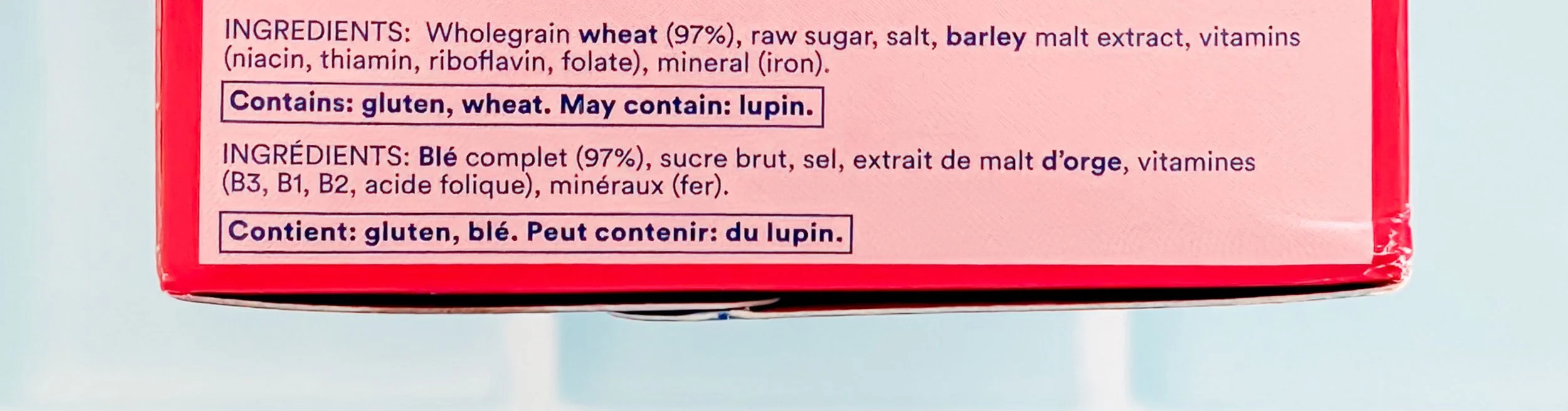
The ingredients list tells you exactly what's in the product, listed in descending order by weight. The first ingredient is always the most abundant - the last is the least.
For Weet-Bix: Wholegrain wheat (97%), raw sugar, salt, barley malt extract, vitamins (niacin, thiamin, riboflavin, folate), mineral (iron).
A few things to notice here:
The first ingredient is wholegrain wheat at 97%. This is exactly what you want to see in a wholegrain cereal - the primary ingredient is the whole grain, not a refined flour or a sugar. The percentage in brackets is voluntary but really helpful when it's there.
The list is short. Six ingredients total. As a general rule, a shorter ingredients list tends to indicate less processing - though this isn't a hard rule.
A note on ingredients you don't recognise. You might have heard the advice "if you can't pronounce it, don't eat it" - but this isn't actually a useful guide to whether something is safe or healthy. Food additives approved for use in Australia have been assessed by FSANZ and deemed safe for consumption. An unfamiliar chemical name doesn't make something harmful - ascorbic acid is just vitamin C, and dihydrogen monoxide is water. If a food is on an Australian supermarket shelf, the ingredients have been through a regulatory approval process. For most people, most of the time, that's enough.
The allergen statement: "Contains gluten, wheat. May contain lupin." This is standardised and required by Australian law. "Contains" means it's a deliberate ingredient. "May contain" means there's a risk of cross-contamination during manufacturing. If you have a food allergy or intolerance, this is the line to check first.
Part 3: The Health Star Rating
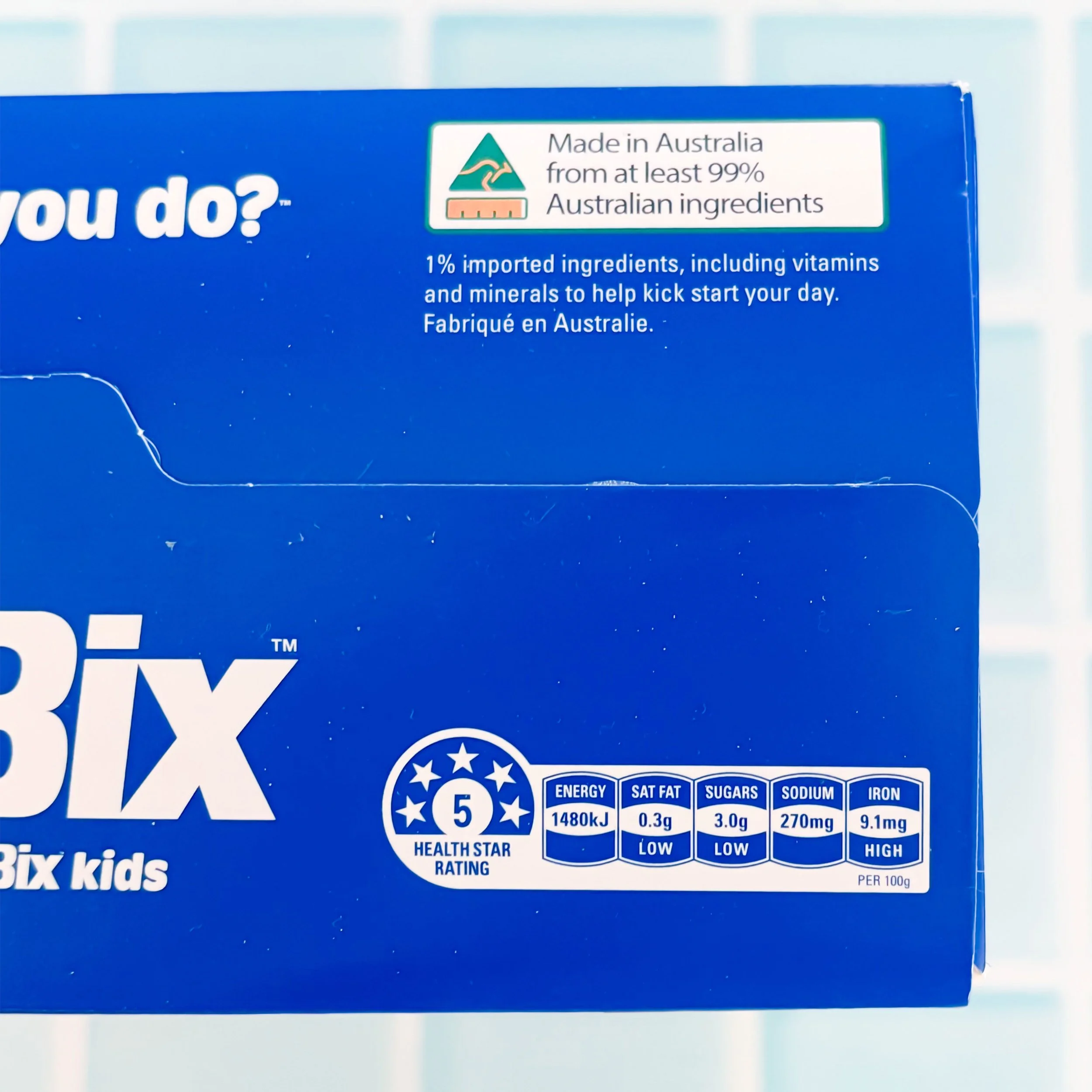
The Health Star Rating (HSR) is a voluntary front-of-pack labelling system used in Australia and New Zealand. It rates foods on a scale of 0.5 to 5 stars based on their overall nutritional profile - the more stars, the healthier the choice relative to similar products.
Weet-Bix has a 5 star rating - the maximum possible. Alongside the stars you'll see a summary panel showing the key metrics it was rated on, all per 100g:
Energy: 1480 kJ
Sat Fat: 0.3g - LOW
Sugars: 3.0g - LOW
Sodium: 270mg
Iron: 9.1mg - HIGH
How the rating is calculated
The HSR algorithm looks at the overall nutritional profile of a food, balancing nutrients that are worth limiting in excess - like saturated fat, added sugars and sodium - against nutrients that are beneficial to prioritise - like protein, fibre, and fruit or vegetable content. Energy is factored in as part of the overall picture. Products with a stronger balance of beneficial nutrients relative to those worth limiting will score higher.
Weet-Bix scores well because it's low in saturated fat, low in sugar, high in fibre and high in iron - a genuinely strong nutritional profile for a cereal.
The important caveat
The Health Star Rating is a useful quick reference tool but it has limitations. It rates products within categories - so a 5 star rating on a processed food doesn't mean it's equivalent to a 5 star rating on whole food. It's designed to help you compare similar products to each other, not to tell you whether a food is "good" or "bad" in absolute terms.
It's also voluntary - not all manufacturers choose to display it, so its absence doesn't mean a product rates poorly. Some companies simply haven't applied for the rating.
Use it as a quick directional guide, not a definitive verdict.
The country of origin label
You'll also notice on this pack: "Made in Australia from at least 99% Australian ingredients" with the green kangaroo logo. This is the Australian Country of Origin labelling system - required by law for food sold in Australia. The kangaroo triangle logo with a percentage indicates how much of the content is Australian grown or produced.
For anyone buying Australian to support local farmers and producers, this is your label.
The practical takeaway
Next time you pick up a packet, here's the order to read it in:
Serving size first - everything else is meaningless without knowing this
Per Serve for your intake, Per 100g for comparisons
Energy - in kJ, divide by 4.2 to get calories
Protein and fibre - the two most underrated numbers on the label
Saturated fat and sodium - the two to keep an eye on
Sugars - useful context but remember it includes natural sugars
Ingredients list - shorter is generally better, first ingredient tells you the most
Health Star Rating - a helpful quick guide for comparing similar products
Allergen statement - essential if you have any food allergies or intolerances
And if you want accurate nutritional data for thousands of Australian foods without having to flip every packet, the Australian Calorie & Nutrition Guide has FSANZ-sourced data organised the way you actually shop - from fresh produce to packaged foods and takeaway.
Want a one-page reference for the key nutrition numbers? Grab the free Nutrition Cheat Sheet - macros, kJ conversions and key terms all in one place.
